My journey towards the dream of a lifetime, sustainable animal breeding and cheese making.
Labels
Life
Cheese
Dairy sheep
I Need Farming
Cheesemaking
Pecorino
Stable
Lacaune
Mobile home
Ram
Cheese Cave
Ireland
Lambs
Land
Birds
F1 cross
Lactic cheese
Raw milk
Ricotta
Shearing
Sustainability
Blogs
Chickens
Curd
Genetics
Gorgonzola
Mozzarella
Nature
Pigs
Reproduction
Starter cultures
Weaning
breeds
fun
humor
people
Translate
Showing posts with label Dairy sheep. Show all posts
Monday, 14 July 2014
About grazing behavior and genetics.
It's one of those lovely wet and damp Irish days. These new lambs I bought recently are surely something. I have to say that even being so small and young they graze so much better than their distant inbred cousins, the dreaded Friesians.
Those East Friesians are hopeless. Get one if you want a pet sheep, because they are totally sweet and tame but stay well away from them if you want something to graze that little bit of waste land you have on the farm. Jeez they are hopeless. They won't touch anything that looks different from lush, green, tasty, fat grass.
On the other hand, the F1 crosses Lacaune x Friesians lambs are all over the place, on the ditch, on top of the brambles, inside the gorse, within the reeds, you name it, you'll find a lamb eating it. It's a pleasure to look at them gnawing at pretty much anything belonging to the plant kingdom. Being F1 crosses they also conserve that tameness typical of the "Hopeless Friesian sheep".
Another thing they do differently is looking for shelter. They will pick the best spot, while the Friesians look like someone trying to protect himself from rain with a leaf.
Ah! do I love genetics!
Fitness is what you loose first when you apply artificial genetic selection to animals. The reason is simple, there is no longer any natural selection pressure to keep there those genes badly needed to survive and thrive in nature, where there is no one to protect you from predators, to supply you with plenty of food and to provide you with shelter and clean water.
The more you push selection for a certain trait, the more you lose fitness in the population.
The exact definition of fitness is the capability of an individual to reach sexual maturity and generate fertile progeny. Basically the capability of passing down your genes to following generations, and of course it has a meaning only in wild and feral populations, in fact domesticated animals cannot choose who will reproduce, their owner is the one to decide who is fit to reproduce. Nevertheless they conserve a certain degree of fitness. An extreme example of this is the Bulldog, where fitness=0. Bulldogs are totally incapable to copulate because they have been bred so wrongly. When they manage, they cannot give birth without a cesarean.
It also depends on the criteria you use for selection. Nowadays selection is carried out with a bit more insight compared to the '80s when a single trait was pursued (quantity of milk as opposed to weight at 60 days). So nowadays you find inside genetic indexes also good things like "leg conformation", "udder shape", "feet index" and so on, all traits that have a positive effect on the fitness of the animal.
This also means that you cannot push as much for "milk quantity" anymore, but that's ok, because that little bit extra came at a big cost in terms of health and animal welfare.
So, Friesians have been selected with very little in mind in terms of fitness and very much towards the one goal: lots of milk, because they were traditionally reared in small flocks, housed and well fed. Furthermore there is no tradition of cheese making from sheep cheese in Friesland, so milk is particularly watered down (little solids in it).
Lacaune on the other hand, have been selected in France, with an eye towards fitness and lamb weight. They are reared on marginal land (Roquefort-sur-Soulzon), hence they need to be able to feed on rough material and thrive in Mediterranean semi-arid conditions. Furthermore their milk is traditionally used for cheese making (Roquefort) and is produced in volumes slightly smaller than Friesians' but with more solids, which is what you need if you make cheese. You cannot make cheese with water!
It's nevertheless quite shocking to see the difference with the purebred Friesian lambs I had last year. Long live the Lacaune cross!!
Thursday, 12 December 2013
Tupping gone wrong
Remember how I said that the ram had serviced all the sheep and that I'd put him in again just in case? Well, it turns out Little Fecker is not that good at fucking, or better, he's not that good at getting them pregnant, because surely he's applying himself a lot.
The result is that I might have as little as only two sheep in lamb (Selvaggia and Concubine), but hopefully the third time around he managed the other 3.
My mistake, I left it too late and when I realized that he didn't work it was too late to get another one. If I went to get another ram now I would have lambing in June, which means milking until January. No way Jose!!! Better be barren for a year, especially now that we only have 4, hopefully we'll make treasure of my mistake and won't do it again.
There is a chance that LF is just inexperienced, that the Frisian sheep are a tiny bit too tall (in fact the only 2 that are not on heat again are the shortest ones), or that LF is not mature yet. Truth is that probably he is infertile but I like him so much that I'll try to keep him, possibly as a teaser ram. Way to go Little Fecker!
The result is that I might have as little as only two sheep in lamb (Selvaggia and Concubine), but hopefully the third time around he managed the other 3.
My mistake, I left it too late and when I realized that he didn't work it was too late to get another one. If I went to get another ram now I would have lambing in June, which means milking until January. No way Jose!!! Better be barren for a year, especially now that we only have 4, hopefully we'll make treasure of my mistake and won't do it again.
There is a chance that LF is just inexperienced, that the Frisian sheep are a tiny bit too tall (in fact the only 2 that are not on heat again are the shortest ones), or that LF is not mature yet. Truth is that probably he is infertile but I like him so much that I'll try to keep him, possibly as a teaser ram. Way to go Little Fecker!
Thursday, 11 July 2013
Sheep
Long post! a bit more technical than usual. After all this blog was supposed to be a small holding blog and not a private diary!
I think the sheep well deserve the first technical post.
The SHEEP.
I always thought that sheep were the most fascinating and versatile domesticated animal on earth. Domestication and then selection of sheep into the vast array of breeds that homo sapiens has produced throughout the millennia is an example to all other domesticated species.
To my knowledge, sheep is the only domesticated mammal that has been selected for three different scopes: meat, milk and wool. The wool aspect in fact is very peculiar. There are examples of mammals domesticated for wool or fine fibre production and meat at the same time, like rabbits and alpacas (although alpaca is not really reared for its meat) or other examples like the bovine, selected for dairy and meat productions. But the sheep is unique in its selection towards three separate attitudes.
The sheep is unique in something else too. It is the only mammal bred for fine fibre production in which selection produced a single coat. Most mammals with a fur have a coat that is composed by an outer coat (hair) and what is mostly referred to as under coat, composed by much finer fibers (dawn). The most prominent example is the Cashmere goat, whose super expensive fiber, produced in the order of a few hundred grams per head, is combed or, more traditionally, picked from the bushes. Cashmere is an under coat.
Basically hair follicles are divided into primary and secondary hair follicles. My PhD supervisor was excellent in his hair biology :) Every primary follicle, producing thick hair, is surrounded by a bunch of tiny, thin, secondary follicles.
But in sheep you basically have a bunch of follicles where you cannot distinguish between primary and secondary anymore, at least not from their diameter, but only from the presence of other anatomical features (sebaceous gland).
Alpacas are going towards that situation too but they are still not there. Or rather, they were probably there before the conquest, or much closer.
Anywhoo, aren’t sheep amazing? :)
So there are sheep selected for meat like the bergamasca
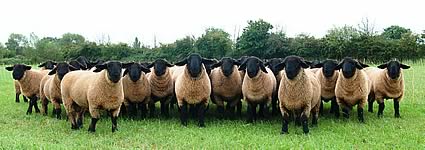
and the suffolk,
but also sheep selected for wool like the merino
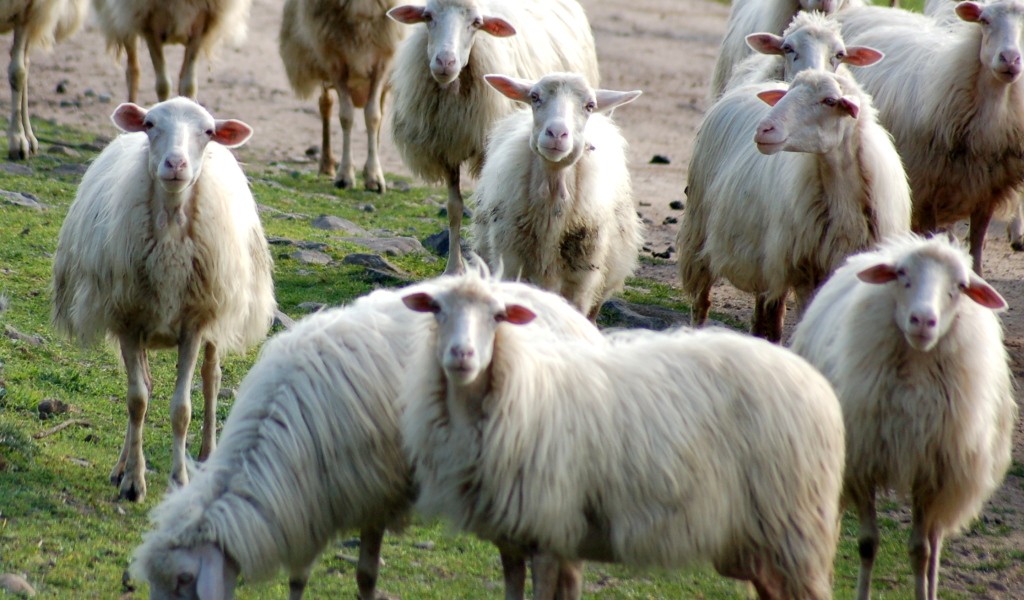
and finally sheep selected for dairy production like the Sarda,
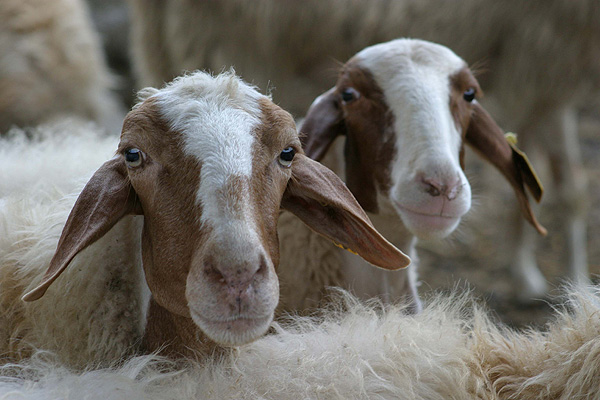
the Comisana,
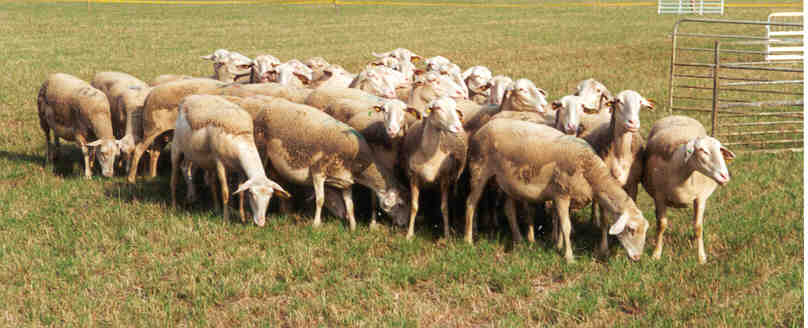
and the Lacaune!
and the East Friesian of course! (and many many others)
Dairy sheep and the use of milk from sheep are surely common in southern Europe and the Mediterranean area, with France, Spain, Italy and Greece, but surely all the Balkans and the middle east too, having plenty of history, breeds and cheese to offer.
In northern Europe dairy breeds are virtually non existent and therefore the traditions that come with them. The only example is in all truth the famous and infamous East Friesian. It is still a mystery to me what such a sheep is doing up there :)
Traditionally they were kept in small flocks with plenty of care and good management to provide milk for the household without the need to have a much larger animal like a cow. This (the intense care) has allowed very intense genetic selection towards a main trait: the quantity of milk. Unfortunately, like it always happens with very intense, mono-directional selection, you end up losing bits and bobs on the way. The result is a sheep that surely will provide you with more milk per head than any other breed on the planet, but has the nutritional needs of a bison and the resistance and toughness of an infant.
I might be exaggerating, but the contrast to other dairy breeds is profound, I can assure you.
Another trait that you usually end up with when selection is so strong is tameness. In fact they are usually very tame animals and this sure is a “pro” for the small holder who is just setting up his/her farm.
So the 4 amazing specimens in my possession are not exactly the kind of breed you’d look for if you want to be sustainable in your farming... But it is the only female dairy genetics that you can source in Ireland at present and that’s the reason I got them.
Another bad reason to have pure blood friesians for us is that we want to process our milk to make cheese and when selection is so intense towards quantity you end up losing in quality. In fact friesian milk has lower solids than the milk from other dairy breeds and it’s pointless to get 100 liters when you could get the same solids (and therefore cheese) with 70, especially considering at what price that extra 30 comes, in terms of extra management, feed and veterinary care...
One positive thing about friesians though, is that if breeding pure friesians is not a good idea, crossing them with other dairy breeds or non dairy breeds gives excellent results:
http://milkingsheep.com/dairy-sheep-breeds/
The F1 crosses, by a phenomenon called the hybrid vigor, will produce above the average of the two parents. This effect is lost with the following generations, but the point is that the genetic gain obtained by crossing with friesians is out of doubt great, gaining usually in quantity without losing in quality.
And this is why I was very excited when I came across a lady in Carlow, just by chance, who had lacaune. She was not selling hoggets or ewes but she’d give me a ram. I wasn’t so sure yet back then but after a few months down the road with the four ladies I was more and more convinced about the choice...
One could object that the Friesians are seemingly delicate because of the poor pastures that I’m using now and sure they could do better on the nicer land, but yet not quite as good as lacaune crosses or pure breed lacaune and at the end of the day it just does not make sense to have friesians if your target is sustainability, it’s like driving a ferrari on a country lane.
Concluding, the plan is to use lacaune rams through the next years and to retain the hoggets, slowly increasing the amount of lacaune blood in the flock, if ever in need to bring back some friesland blood I’d use a friesian ram on a small subset of sheep and possibly a year later use the resulting male F1 offspring to service the rest of the flock. That would inject instantly an average of 25% of friesian blood in the coming offspring.
Another alternative would be to use some Zwartbles genes, but that would not go towards quantity but rather towards an increase in offspring size, without losing much at all on milk production.
Exciting!
I think the sheep well deserve the first technical post.
The SHEEP.
I always thought that sheep were the most fascinating and versatile domesticated animal on earth. Domestication and then selection of sheep into the vast array of breeds that homo sapiens has produced throughout the millennia is an example to all other domesticated species.
To my knowledge, sheep is the only domesticated mammal that has been selected for three different scopes: meat, milk and wool. The wool aspect in fact is very peculiar. There are examples of mammals domesticated for wool or fine fibre production and meat at the same time, like rabbits and alpacas (although alpaca is not really reared for its meat) or other examples like the bovine, selected for dairy and meat productions. But the sheep is unique in its selection towards three separate attitudes.
The sheep is unique in something else too. It is the only mammal bred for fine fibre production in which selection produced a single coat. Most mammals with a fur have a coat that is composed by an outer coat (hair) and what is mostly referred to as under coat, composed by much finer fibers (dawn). The most prominent example is the Cashmere goat, whose super expensive fiber, produced in the order of a few hundred grams per head, is combed or, more traditionally, picked from the bushes. Cashmere is an under coat.
Basically hair follicles are divided into primary and secondary hair follicles. My PhD supervisor was excellent in his hair biology :) Every primary follicle, producing thick hair, is surrounded by a bunch of tiny, thin, secondary follicles.
But in sheep you basically have a bunch of follicles where you cannot distinguish between primary and secondary anymore, at least not from their diameter, but only from the presence of other anatomical features (sebaceous gland).
Alpacas are going towards that situation too but they are still not there. Or rather, they were probably there before the conquest, or much closer.
Anywhoo, aren’t sheep amazing? :)
So there are sheep selected for meat like the bergamasca
and the suffolk,
but also sheep selected for wool like the merino
and finally sheep selected for dairy production like the Sarda,
the Comisana,
and the Lacaune!
and the East Friesian of course! (and many many others)
Dairy sheep and the use of milk from sheep are surely common in southern Europe and the Mediterranean area, with France, Spain, Italy and Greece, but surely all the Balkans and the middle east too, having plenty of history, breeds and cheese to offer.
In northern Europe dairy breeds are virtually non existent and therefore the traditions that come with them. The only example is in all truth the famous and infamous East Friesian. It is still a mystery to me what such a sheep is doing up there :)
Traditionally they were kept in small flocks with plenty of care and good management to provide milk for the household without the need to have a much larger animal like a cow. This (the intense care) has allowed very intense genetic selection towards a main trait: the quantity of milk. Unfortunately, like it always happens with very intense, mono-directional selection, you end up losing bits and bobs on the way. The result is a sheep that surely will provide you with more milk per head than any other breed on the planet, but has the nutritional needs of a bison and the resistance and toughness of an infant.
I might be exaggerating, but the contrast to other dairy breeds is profound, I can assure you.
Another trait that you usually end up with when selection is so strong is tameness. In fact they are usually very tame animals and this sure is a “pro” for the small holder who is just setting up his/her farm.
So the 4 amazing specimens in my possession are not exactly the kind of breed you’d look for if you want to be sustainable in your farming... But it is the only female dairy genetics that you can source in Ireland at present and that’s the reason I got them.
Another bad reason to have pure blood friesians for us is that we want to process our milk to make cheese and when selection is so intense towards quantity you end up losing in quality. In fact friesian milk has lower solids than the milk from other dairy breeds and it’s pointless to get 100 liters when you could get the same solids (and therefore cheese) with 70, especially considering at what price that extra 30 comes, in terms of extra management, feed and veterinary care...
One positive thing about friesians though, is that if breeding pure friesians is not a good idea, crossing them with other dairy breeds or non dairy breeds gives excellent results:
http://milkingsheep.com/dairy-sheep-breeds/
The F1 crosses, by a phenomenon called the hybrid vigor, will produce above the average of the two parents. This effect is lost with the following generations, but the point is that the genetic gain obtained by crossing with friesians is out of doubt great, gaining usually in quantity without losing in quality.
And this is why I was very excited when I came across a lady in Carlow, just by chance, who had lacaune. She was not selling hoggets or ewes but she’d give me a ram. I wasn’t so sure yet back then but after a few months down the road with the four ladies I was more and more convinced about the choice...
One could object that the Friesians are seemingly delicate because of the poor pastures that I’m using now and sure they could do better on the nicer land, but yet not quite as good as lacaune crosses or pure breed lacaune and at the end of the day it just does not make sense to have friesians if your target is sustainability, it’s like driving a ferrari on a country lane.
Concluding, the plan is to use lacaune rams through the next years and to retain the hoggets, slowly increasing the amount of lacaune blood in the flock, if ever in need to bring back some friesland blood I’d use a friesian ram on a small subset of sheep and possibly a year later use the resulting male F1 offspring to service the rest of the flock. That would inject instantly an average of 25% of friesian blood in the coming offspring.
Another alternative would be to use some Zwartbles genes, but that would not go towards quantity but rather towards an increase in offspring size, without losing much at all on milk production.
Exciting!
Monday, 8 April 2013
Another two female lambs!
Remember the hogget I wasn't sure if was pregnant at all? Well, in the last two weeks it had become clear that she was but I still was not sure if she had twins or not, she really was still quite small. And she all surprised us today with two tiny but beautiful girls, both vital and sucking :) the smaller one weighs only 2.5 kg and the "big one" only 3. I had noticed that she was pacing and being a bit uncomfortable, so I left her inside and within 15 minutes she had popped them both out. What a surprise Selvaggia! The wild one is now being a lovely mum. Here are the pics:
![]() |
| 2013-04-08 |
Friday, 5 April 2013
Tragedy avoided
Last Saturday I went with Chiara to pick up a young ram in Carlow. I got him at a good price from a breeder of Lacaune who also makes cheese. Well, the little fella was very well behaved and pretty chilled out during the long trip back and he also seemed to adapt to his new place. I had put him where the sheep were first. Then the poor thing had a close encounter with the dogs and got pretty scared. The day after, as soon as he saw Peps, he took off and jumped like a wild animal the 5ft fence and took for the hill. Off he was. Gone, never to be seen in the next 2 days and nights. We went around the whole place and spoke to neighbors etc etc. Then this morning I spotted him on top of the hill above the stable, he was looking at me. I locked the dogs and went up with a bucket and some feed. Although he came closer, he never followed me. So I got back and got the sheep in the upper field and he of course came down because he couldn't resist the appeal of those sexy sheep :) and after some introductions he was in the fence with them. At night he came back with them and slept with them. Tonight I managed somehow to put him into his dedicated space in the big stable. He's a lively fella and he doesn't like to be alone...
In the meantime we also had another two lambs, one female and one male, which brings the total to 2 females and 2 males so far.
The Lacaune is a french dairy breed that is more similar to a Mediterranean one. Their production is smaller but the milk is richer. It is closer to the type of sheep we're looking for, low maintenance, smaller and with better milk. I'm very curious to see how the F1 crosses will perform.
Enjoy the pics
In the meantime we also had another two lambs, one female and one male, which brings the total to 2 females and 2 males so far.
The Lacaune is a french dairy breed that is more similar to a Mediterranean one. Their production is smaller but the milk is richer. It is closer to the type of sheep we're looking for, low maintenance, smaller and with better milk. I'm very curious to see how the F1 crosses will perform.
Enjoy the pics
Tuesday, 26 March 2013
Laaaaaaaaaaaaaaaambs!
So Laura, P. and Mr Linux got to see two lams just during their short visit! Isn't that great?
Friday, 15 February 2013
Afternoon off

Hi all, this morning I woke up feeling like shit. I think I am incubating some bug. I still went to shovel some shit at Sean's farm but left a bit earlier with his understanding. After all the first thing he said this morning when he saw me was "you look like shit Jonzie".
But I did watch "The life of Brian" for the first time in my life last night! I know! when I went back to the mobile home I couldn't start the fire, what a pussy eh?
Anyhoo, I gave up and went to bed and that probably did it for me.
The stable is almost done. John the builder will come on Monday to finish off the last bit of sheeting and the two perspects on the roof. The plastering is not top notch but hopefully will do what is supposed to do, keep out the water.
The ladies are doing great and going happily into their last 2 months of pregnancy.
Polls are open, what do you think we'll get? how many lambs? and how many females out of them? Take part in the polls on the sidebar and we'll get some cheese for the winners!!
Saturday, 19 January 2013
Overwhelming
Overwhelming is a nice English word, it doesn't really have an exact translation in Italian but describes very well a specific feeling. If I had to translate it in Italian I'd have to use several words or sentence like "Travolgente, oppressivo, mancanza di controllo, sensazione di sopraffazione".
There, it's the feeling I get when I have to think about or carry out too many tasks for my limited brain capacities.
At the moment I have to deal with:
Enjoy the video and sorry for the mess.
There, it's the feeling I get when I have to think about or carry out too many tasks for my limited brain capacities.
At the moment I have to deal with:
- The lack of a trailer to get haylage.
- Looking for a trailer
- The seriously low reserves of haylage.
- Seriously low fire wood!
- A reed bed system for the mobile home and the waste pipes
- A never ending construction of the stable
- People that don't call back that should build the never ending stable
- Various shit due to the change of residency
- Porch to be finished
- Furniture in the porch going moldy
- etc etc etcetera
Enjoy the video and sorry for the mess.
Wednesday, 5 December 2012
Hi
Long time no post, as usual.
It's been pretty hectic but I finally got sheep! They are 4 beautiful specimens of friesian sheep, 2 hoggets and two ewes at second lactation. We were lucky enough to find them this late in the season.
Aren't they beautiful P?
I have a few problems, including the fact that the 2 ewes are likely still milking and I haven't managed to milk them yet because the set up is not optimal, they are still pretty shy and don't like their temporary dorm.
They seem in good health though and they are getting friendlier and less scared by the day.
Tonight they went running after me when I got in with the red bucket (the red bucked brings good stuff), and they even entered the tiny stable. There is hope I'll manage to check the udders tomorrow.
The decking is finished too, and is a big plus for my living space:
While the stable is sort of stuck in a half finished stage. Big mess with the order for the sheeting by the coop.
More soon
It's been pretty hectic but I finally got sheep! They are 4 beautiful specimens of friesian sheep, 2 hoggets and two ewes at second lactation. We were lucky enough to find them this late in the season.
Aren't they beautiful P?
I have a few problems, including the fact that the 2 ewes are likely still milking and I haven't managed to milk them yet because the set up is not optimal, they are still pretty shy and don't like their temporary dorm.
They seem in good health though and they are getting friendlier and less scared by the day.
Tonight they went running after me when I got in with the red bucket (the red bucked brings good stuff), and they even entered the tiny stable. There is hope I'll manage to check the udders tomorrow.
The decking is finished too, and is a big plus for my living space:
While the stable is sort of stuck in a half finished stage. Big mess with the order for the sheeting by the coop.
More soon
Sunday, 30 October 2011
A long Autumn
Back to serious talking... I have been thinking about a post in which I explained what is our time schedule and what are the things needed to be done but after much thinking I came to the conclusion that it is not such a good idea, because it's way too early for that. We still haven't talked with the competent offices yet and although I have been reading the relative legislation in terms of agricultural building permissions and food business, there is still too much prospecting to be done.
The only sure thing is that whatever we'll need to do, we'll have to do it at a specific time. In fact, sheep are seasonal animals and they do not have oestrus cycles all year round.
Sheep start having regularly spaced oestrus cycles (17 - 19 days long) with the decrease of daily light (short day breeders), which means in August at the earliest (in the northern hemisphere). If they are not mated they stop cycling regularly in spring when days get longer once again. This means that in the northern hemisphere the best time to mate ewes is around October-November (it really depends on the climatic region and market needs) so that they are ready for delivery in early spring after a 5 months long pregnancy.
That's when they start producing milk.
Therefore the only two known deadlines are: i) to get a stable (or a simple shed) ready by late summer and ii) a cheese cave ready by early spring.
Everything goes around this two major deadlines and if you miss them you'll lose a whole year of learning and production.
There are also of course a ton of other things to be done like a new and upgraded electric connection, refrigeration units, a well and so on. So you can understand that P. and I have our hands tied for now, and we can't even practice or help around in nearby sheep farms because they are not producing cheese at the moment.
I have planned a trip around Christmas holidays to try and get quotes for materials so that we can get a better figure of the investment needed and I would also like to try and speak with local vet services, small business authority and food business regulators. But that is it. This was really a bummer because I feel like I'm wasting my time here, so I decided to keep myself busy and at the same time to get some experience under my belt by engaging in some cheese making at home.
The thorn apart thing you see in the picture at the top of the post is the second hand fridge that, after the due modifications, will serve as a home made cheese cave.
More soon :)
Wednesday, 19 October 2011
Pecore e pecorino
It's been a bit difficult recently to post and I might have lost the line of thought I was trying to follow.
I'm trying to get back on track with this post and focus on the issue we left unresolved: sheep.
I explained in a previous post how we ended up to choose dairy sheep as our main project on the farm. An important extra reason is also the fact that I'm already familiar with sheep and small ruminants in general.
We are plenty of dairy sheep in Italy and cheese-making from sheep milk has a long tradition that goes back in time to pre-Roman times.
The two main cheeses made with milk from sheep are the Pecorino in its various forms and the Ricotta (either fresh or aged). It is a typical and abundant production all along the appennini area from north to south but mainly in central Italy and Sardinia.
People producing Pecorino are also usually producing Ricotta which is obtained from boiling the whey after having made pecorino.
Italian breeds are definitely numerous but probably not that well adapted to the lush Irish pastures and the wet conditions.
There are very few dairy breeds in northern Europe and the two that could be more easily sourced would be the ever surprising East friesian and the British milksheep (which is anyway a friesian cross).
These babies are reported to produce up to 600Kg (East friesian) or 900 for the British milksheep during a lactation of up to 300 days. These figures are probably a bit optimistic because they probably refer to sheep housed in excellent conditions and fed shitloads of protein and feed-stuff while we would rely almost solely on the grazing and hay. Also we'll probably go for east friesian crosses and not pure-breed.
If you're trying to understand how much money we can make from cheese I'll tell you right now we won't get rich but P. and me should be able to live a decent life nevertheless.
Even considering a 200 Kg yearly milk production and a yield in cheese around 17% for a price of 20 Euro/Kg, each sheep should produce a minimum of 600 Euro/year. It is an estimate taking into account expenses such as vaccinations and treatments, electricity and such. It is also quite pessimistic, because in fact milk production, cheese yield and selling price should be quite higher. I've seen industrial sheep cheese in supermarkets in the area sold at 35 Euro/Kg!
Then there is the little extra from lambs and wool, although there is little money in there.
It's late, I should go to bed. More soon :) Enjoy the video
Friday, 30 September 2011
What to do?
I have been away for a few days and I sort of lost my posting schedule, I'm one of those people still refusing to get a smartphone. I was in Sarajevo for a weekend to visit a dear friend. I was so excited when I left that I forgot my camera and I couldn't find a disposable one in Sarajevo. Therefore, No pictures but lots of good memories.
It's time to talk about P.'s and my plans and about the way we want to use this land's potential.
Whizzie has of course her own plans and I'll probably write about those too, if she wants, but for now let's talk sheep.
In fact this is what we want to breed: sheep! I love sheep! they are so cute! Ok I'm joking, that's not why we went in that direction :)
Sheep were almost an obligate choice. As you might know, if you want to sustain your animals with the land you have at your disposal throughout the whole year, you have to consider animal density as a crucial factor. Animal density is calculated using the so called Livestock Units (LUs). One hectar of pasture is sufficient to sustain 1.0 LU through the whole year and this corresponds to an adult dairy cow. Now, here's a good page with some comparisons: Grazing Livestock Units equivalents, and another one with pigs too: Eurostat.
So, for an 8 hectare farm, dairy cows, horses or beef would not be a good choice because you'd be able to keep at most 10 of them and even using intelligent market strategies it would be difficult to get a decent amount of money out of such a small number of animals. Plus, these are big animals, need big housing solutions and big milking facilities.
Another possible solution I explored at the beginning was breeding sows/pigs for the production of cured meats. Unfortunately the land at our disposal is not suitable for extensive/outdoor pig rearing and it's actually a bit of a waste. Pigs thrive in woods in marginal steep areas and it is a kind of production that is coming back in Italy where we have lots of those woods with oaks, holm oaks, chestnuts and so on, but putting them on green, lush pasture? No thanks. They do that in the UK but the only difference with pigs reared intensively is that they live in a field, but you still have to provide 95% of the diet. A bit of a waste of space if you ask me.
So we were left really with two options: chickens and sheep. There isn't a rabbit culture in Ireland and like in the UK they are considered either a pest or a pet :)
Regarding the chickens, hens, eggs and so on, there is a lot of competition already, it seems like it has become the new sector of enterprise for every single hippie in West Cork. So we might get a reasonable number of hens but only to optimise pasture gains (more later on this).
Sheep sound good because 1 adult sheep is considered to be between 0.1 and 0.2 LUs. This means that Whizzie's land could sustain at least 40 adult sheep. Now, if we were talking just meat/wool breeds the figure would have been closer to 80 animals but money in meat and wool is very little and we want to go dairy. A better figure for dairy sheep in terms of density is probably closer to 0.2 LUs.
Dairy sheep sound a lot better because although the wool is of lower quality, the meat is pretty much still there and the added value you can get from transforming milk into cheese is among the biggest around (it's up there with cured meats).
So, I'll leave you with that. Start imagining beautiful dairy sheep and lots of cheese, I can tell you, this image has been haunting us in our sleep for quite a while.
Subscribe to:
Posts (Atom)